
More Than Paperwork: The Ultimate Guide to Monthly Inspections - Ep1
The Alliance Edge
How Monthly Inspections Actually Work — And Why They're the Most Important Thing You Do,"
is a complete training guide for One Janitorial Alliances on conducting monthly building inspections. It stresses that the inspection is the single most powerful tool for protecting income, proving professionalism, and building lasting client trust
.
The training is divided into the purpose, process, and detailed section-by-section requirements of the monthly inspection.
Core Importance and Consequences
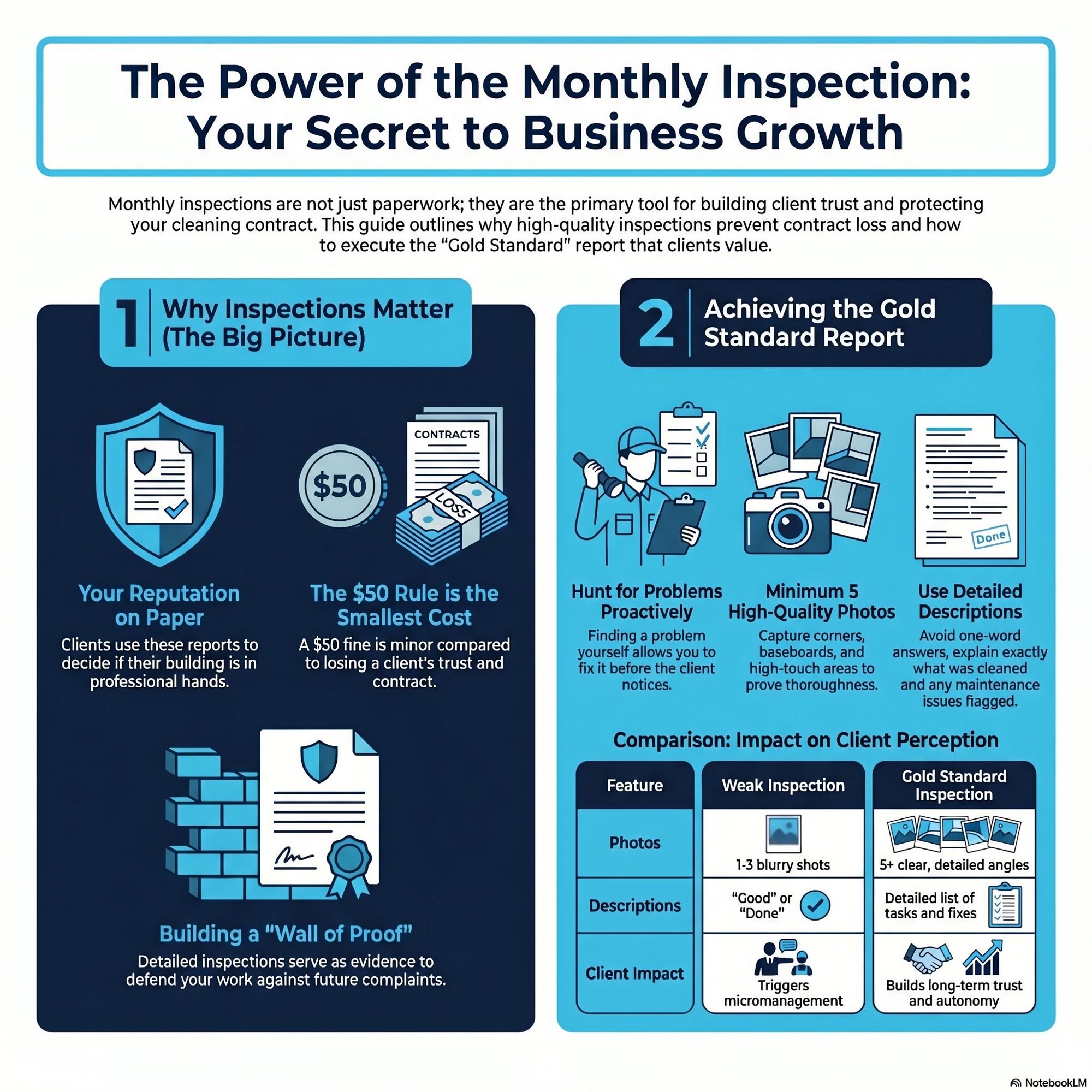
Trust and Reputation: Commercial cleaning is built on trust, which must be earned every month. The inspection is your "reputation on paper" and is actively read and filed by clients to determine if their building is in good hands.
Protection: A detailed inspection history provides evidence to defend your work if a client complaint arises. A lack of inspections leaves the alliance undefended, which can lead to losing the building.
The $50 Rule: Missing an inspection results in an automatic $50 deduction, but the real cost is the client's loss of confidence.
Photo Reuse: You must never reuse photos from previous months, as clients and the internal team will notice, which destroys trust because it suggests you are faking the inspection.
Inspection Process and Mindset
Integration: The inspection is the final step and part of the clean, not something extra to do later.
Methodology: Start at the back of the building and work toward the front, using a flashlight and white gloves mindset to check every single area up to ten feet high.
Proactive Mindset: The goal is to actively look for problems so you can fix them before the client ever sees them. This is how a business owner prevents complaints.
Inspection Form Sections
The form includes eight main sections. For every applicable section, you must fill it out completely with photos, honest ratings, and detailed descriptions
.
Periodic Work and Self-Assessment
Periodic Work: Must be completed on the last weekend of each month. Descriptions must individually list every specific task completed (e.g., "Deep cleaned restroom grout," "Polished all door handles"), not just a general statement.
Self-Assessment Questions: Use these three questions to show maturity and self-awareness.
Improvement: Honestly assess areas to get better at, showing you are a business owner, not an employee (e.g., "I want to get better at efficiency in the restrooms").
Going Well: Specifically highlight strengths (e.g., "The office area has been consistently excellent. Zero complaints in three months").
Information for Client: Use this line of communication to flag maintenance issues or suggest improvements (e.g., "The back door deadbolt is getting harder to lock," "Recycling bins are overflowing by Thursday").
If you are drafting one of these reports and English is not your first language, you can use a free tool like ChatGPT or Claude to write detailed, professional descriptions from your rough notes
.
Would you like me to focus on one of the sections, such as the requirements for the
Restrooms
or the
Periodic Work
, and elaborate on the best practices?
Loading